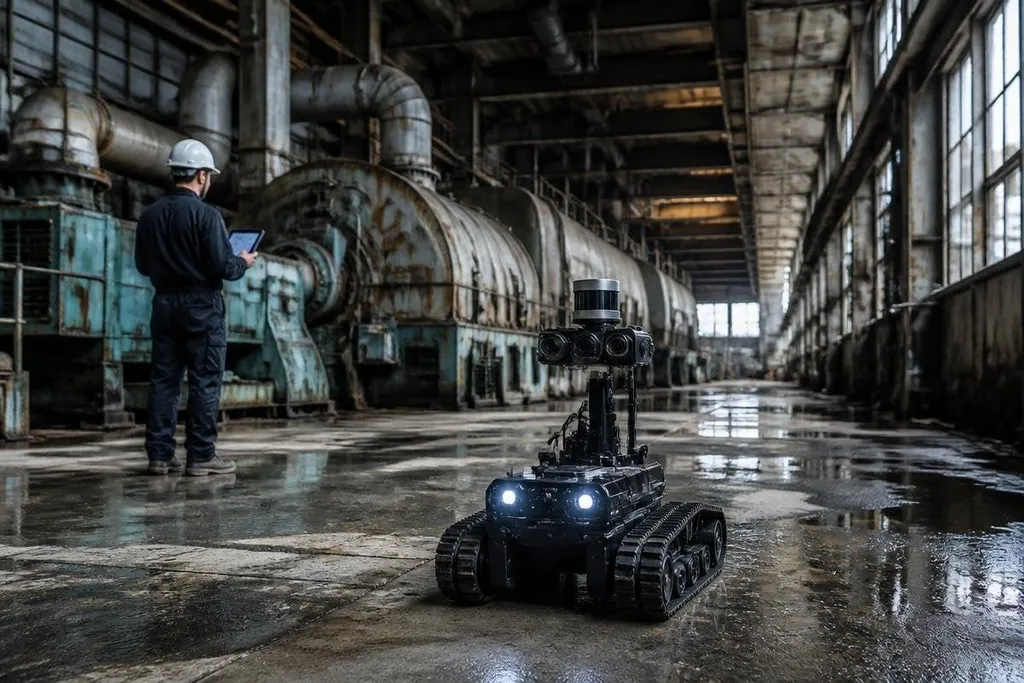
A retired power plant still contains hot surfaces, weak floors, trapped gases, heavy equipment, and material that may be contaminated. Robots can inspect those areas, carry tools, and send back clear data before a worker enters.
- Inspection first: cameras, LiDAR, and gas sensors can check rooms and structures from a distance.
- Remote work: tracked robots, robotic arms, and drones can handle selected tasks near hazards.
- People stay in control: licensed crews still plan the work, approve actions, and manage waste.
The jobs robots can do
Decommissioning starts with knowing what remains inside the plant. A mobile robot can enter a boiler room, turbine hall, cable passage, or service tunnel with a camera and gas sensor. LiDAR, which measures distance with laser pulses, can map walls, pipes, and blocked paths.
That information helps crews find damaged floors, standing water, loose insulation, and equipment that still carries heat or pressure. It also gives engineers a record of the site before machines or structures are cut apart.
A tracked platform can carry a robotic arm across rough floors, though stairs, narrow doorways, cables, and poor radio signals can stop it. The arm can hold a camera, radiation detector, cutting tool, or gripper. Those limits matter because old plants were built for people and fixed equipment, not mobile robots.
Nuclear and fossil plants need different tools
A retired coal or gas plant may contain heavy steel, ash, oil residues, asbestos, and damaged electrical systems.
Robots can help survey these areas, remove loose material, or support cutting and lifting work. The machine still needs a planned route and a way to recover it if a motor, battery, or communications link fails.
Nuclear sites add radiation, contamination controls, and strict rules for waste handling. At a nuclear site, the machine may inspect a hot cell, move a tool, or collect readings, but it doesn't remove the need for trained nuclear workers. Some work also needs a tether, shielded controls, or a machine that can be cleaned before leaving a controlled area.
The task changes the robot choice. A small tracked vehicle may suit a narrow passage. A long-reach arm may keep a worker farther from a contaminated surface. A drone may inspect a tall structure, but dust, heat, airflow, and signal loss can make flight unreliable indoors.
Data matters as much as movement
The useful output isn't a dramatic video. It is a site record that shows where an object is, what condition it is in, and what the crew should do next.
That record may combine photographs, 3D scans, temperature readings, gas measurements, and radiation readings. Engineers can use it to plan cuts, mark exclusion zones, and estimate the tools and containers needed for each work area.
Old power plants put robot claims under a hard test: did the machine inspect a real work area, or only a clean demonstration? Robotics reporting from Robot24.com can tie that claim to the machine, task, test date, and human handoff. That record makes it easier to judge where a person still needs to guide the robot.
Teleoperation remains a practical choice for many jobs. An operator can drive the robot, move an arm, and react to a changing scene while the machine handles the weight and exposure. More autonomous control may help with repeat inspections, but a plant full of unknown obstacles is a poor place to trust an untested system.
The limits buyers need to price in
Exposure can drop with a robot, but the machine also adds work. Crews must move it into the plant, check its sensors, protect its cables, charge its batteries, clean contaminated parts, and keep spare components ready.
The robot may fail at the worst location. Recovery can require a second machine, a manual lifting plan, or a worker entering the area after all. A camera also can't tell an engineer whether a pipe will hold a load unless the system carries the right sensor and the team knows how to read the result.
I'd buy a robot for a defined inspection or handling task, not as a general replacement for a decommissioning crew. The case gets stronger when the same route repeats, the hazard is known, and the machine can be recovered without sending someone into the danger zone.
A practical buying checklist
Before choosing a robot for an old plant, check these points:
- Name the hazard: heat, gas, radiation, unstable flooring, contamination, or heavy lifting.
- Set the route: measure doors, stairs, turning space, floor gaps, and radio coverage.
- Choose the tool: camera, LiDAR, gas sensor, radiation detector, arm, gripper, or cutter.
- Plan recovery: decide how crews will retrieve the robot after a fault or lost signal.
- Define the record: specify the photos, scans, readings, and files engineers need afterward.
- Price the support: include batteries, cleaning, spare parts, training, and operator time.
The next step is a small, repeatable inspection in one known area. If the robot returns usable data without adding a new exposure or recovery problem, the plant has a reason to use it again; if it cannot, a remote camera on a simpler carrier may be the better purchase.